Galectin-3 and Lung Fibrosis: Connecting Fibrotic Signaling, Target Engagement, and Clinical Evidence
What Is Lung Fibrosis?
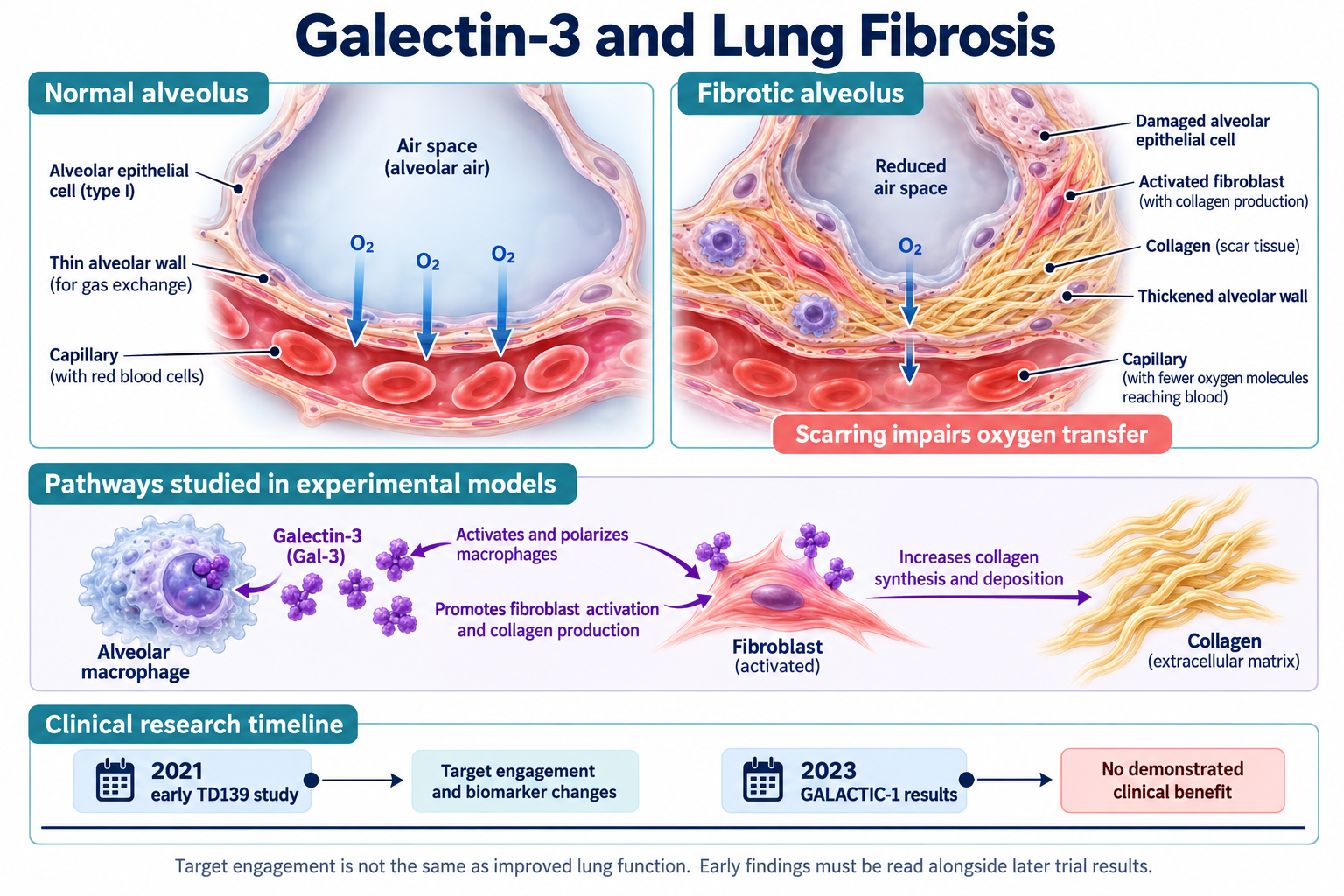
Lung fibrosis, or pulmonary fibrosis, involves scarring that can make lung tissue thick and stiff. Changes around the alveoli, the lungs' air sacs, can impair oxygen transfer and make breathing more difficult.
Idiopathic pulmonary fibrosis (IPF) is a specific form in which the cause is unknown. It is not interchangeable with every disease that causes lung scarring. Symptoms commonly include breathlessness and cough, and progression varies between individuals. [4]
Galectin-3 (Gal-3) has been studied because of its involvement in cellular responses linked to scar formation. Evidence ranges from experimental models to clinical trials, with different conclusions at different stages.
Experimental Studies Connect Galectin-3 With Fibrosis
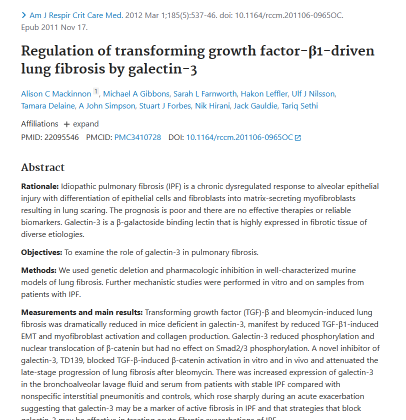
A 2012 study examined Galectin-3 in TGF-β1-driven and bleomycin-induced lung fibrosis. These mouse models reproduce selected aspects of scarring rather than the full complexity of human IPF.
Mice lacking Galectin-3 developed less fibrosis, with reduced myofibroblast activation and collagen production. Cell experiments implicated Galectin-3 in the response to transforming growth factor beta 1 (TGF-β1), a signal involved in fibrotic remodeling.
The Galectin-3 inhibitor TD139 also attenuated fibrosis progression in the experimental setting. These results provided a rationale for human research, but animal efficacy does not establish benefit in patients. [1]
Human Samples Showed Altered Galectin-3 Levels
The same study reported elevated Galectin-3 in bronchoalveolar-lavage fluid and serum from people with stable IPF, with higher levels during acute exacerbations.
These observations connect Galectin-3 with human lung disease. However, finding higher protein levels does not by itself show that the protein caused the disease or that lowering it will improve lung function. [1]
An Early Trial Demonstrated Target Engagement
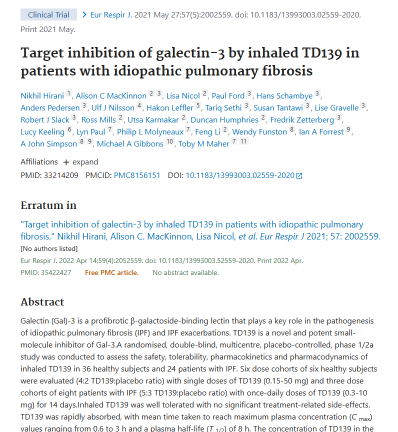
A phase 1/2a study published in 2021 evaluated inhaled TD139 in 36 healthy participants and 24 people with IPF. Patients with IPF received repeated dosing for 14 days.
Researchers measured drug exposure in the lung and changes in Galectin-3 expression on alveolar macrophages. The findings supported target engagement and showed changes in selected circulating biomarkers.
Target engagement means that a treatment measurably affects its intended biological target. It is different from demonstrating slower disease progression, improved breathing, or longer survival. This small, short trial was not a definitive test of those outcomes. [2]
The Later GALACTIC-1 Trial Did Not Demonstrate Benefit
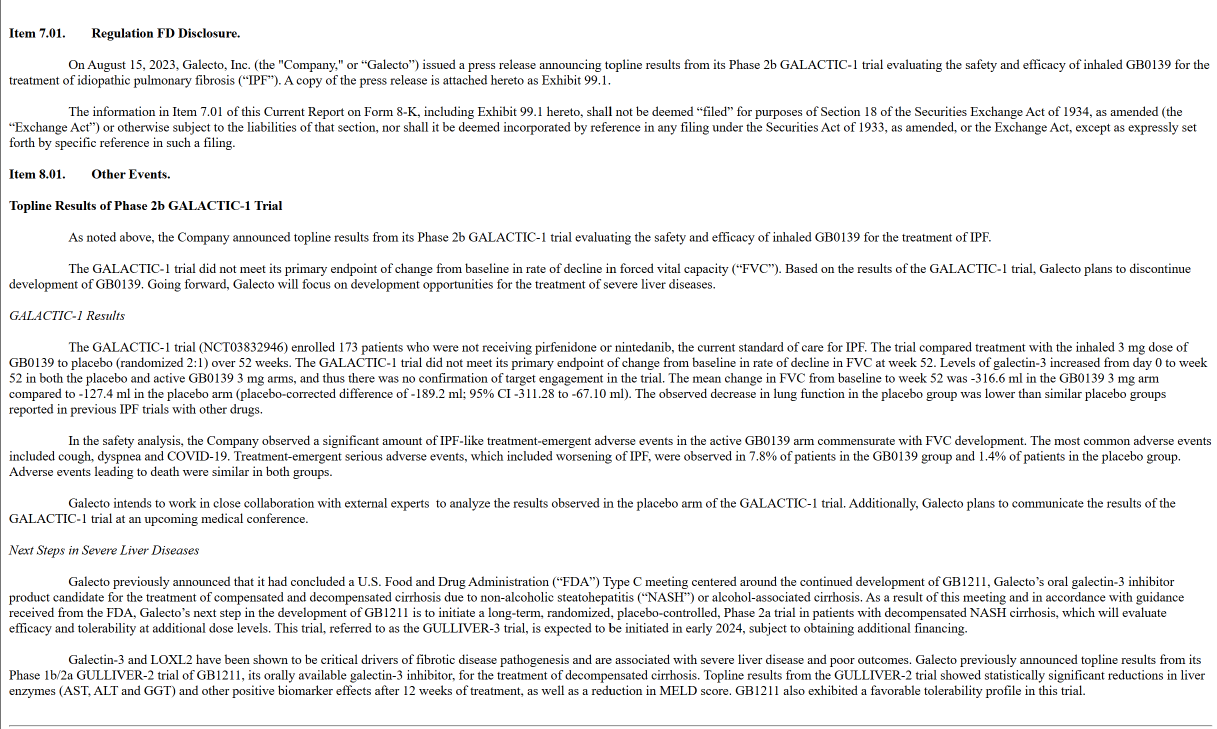
The later phase 2b GALACTIC-1 trial evaluated GB0139, also known as TD139, over 52 weeks. The sponsor reported results in 2023 and subsequently disclosed them in an SEC filing.
The trial did not meet its primary endpoint concerning decline in forced vital capacity (FVC), a measure of the amount of air a person can forcefully exhale.
The sponsor reported greater average FVC loss in the active-treatment group than in the placebo group, and no confirmation of target engagement in that trial. Development of GB0139 was discontinued based on those findings.
These later results must accompany discussion of the earlier biomarker study. Presenting only the encouraging early findings would give an incomplete picture. [3]
Why Is Galectin-3 of Scientific Interest?
Galectin-3 remains relevant to understanding the biology of lung scarring. The evidence illustrates three separate research questions:
Mechanism: does Galectin-3 influence fibrotic pathways in experimental systems?
Target engagement: can an intervention alter the intended target in people?
Clinical efficacy: does it improve meaningful outcomes compared with a control?
Positive results for the first two questions do not guarantee a positive answer to the third.
The evidence summarized here does not establish Galectin-3 inhibition as an effective treatment for IPF or lung fibrosis generally. Findings from one compound also should not be treated as definitive results for every intervention directed at the same target.
Scientific Foundations: The Evidence for Galectin-3 and Lung Fibrosis
-
![]()
Journal: American Journal of Respiratory and Critical Care Medicine
Regulation of transforming growth factor-β1-driven lung fibrosis by galectin-3 (2012)
-
![]()
Journal: European Respiratory Journal
Target inhibition of galectin-3 by inhaled TD139 in patients with idiopathic pulmonary fibrosis (2021)
-
![]()
Trial results: Galecto sponsor results
GALACTIC-1 phase 2b trial results disclosed in Form 8-K (2023)