Galectin-3 and Lewy Body Dementia: Connecting Lewy-Body Pathology, Lysosomal Damage, and Neuroinflammation
What Is Lewy Body Dementia?
Lewy body dementia (LBD) is an umbrella term that includes dementia with Lewy bodies (DLB) and Parkinson's disease dementia. These related conditions are associated with abnormal deposits of alpha-synuclein, a protein found in Lewy bodies.
Symptoms can involve thinking and attention, visual hallucinations, movement, and sleep. The clinical pattern and timing of symptoms help distinguish the related diagnoses. [5]
Galectin-3 (Gal-3) is being investigated in connection with Lewy-body pathology, cellular damage responses, and brain immune activity. Direct tissue observations and related laboratory models provide different kinds of evidence.
Galectin-3 Has Been Observed in DLB Lewy Bodies
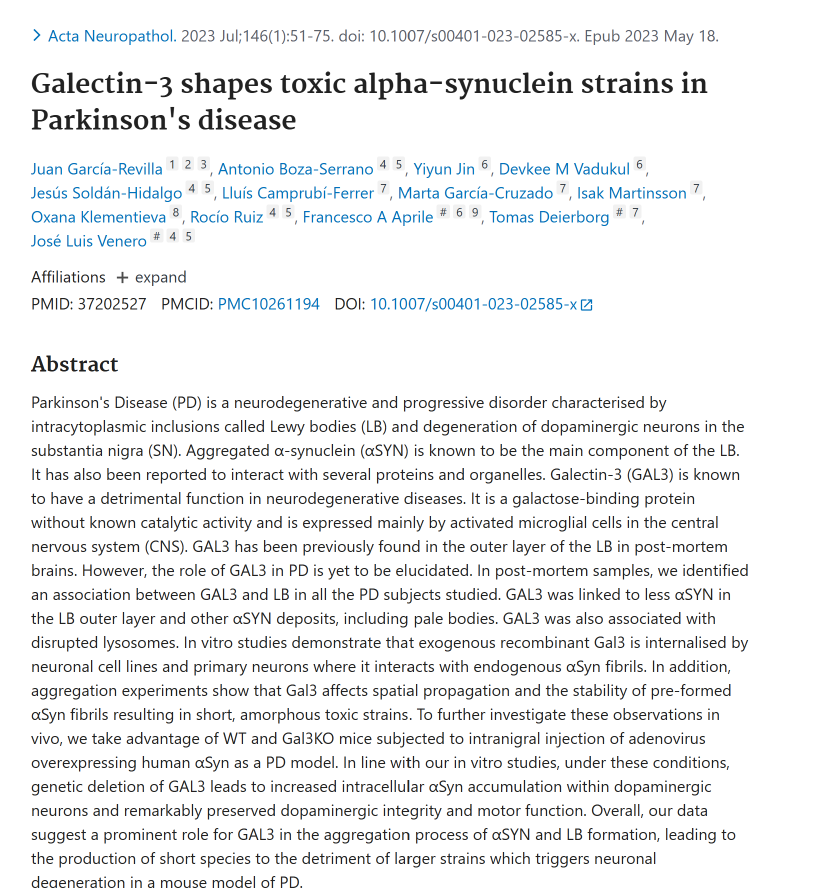
A 2023 study examined post-mortem brain samples from people with DLB as part of a broader investigation of Galectin-3 and alpha-synuclein pathology.
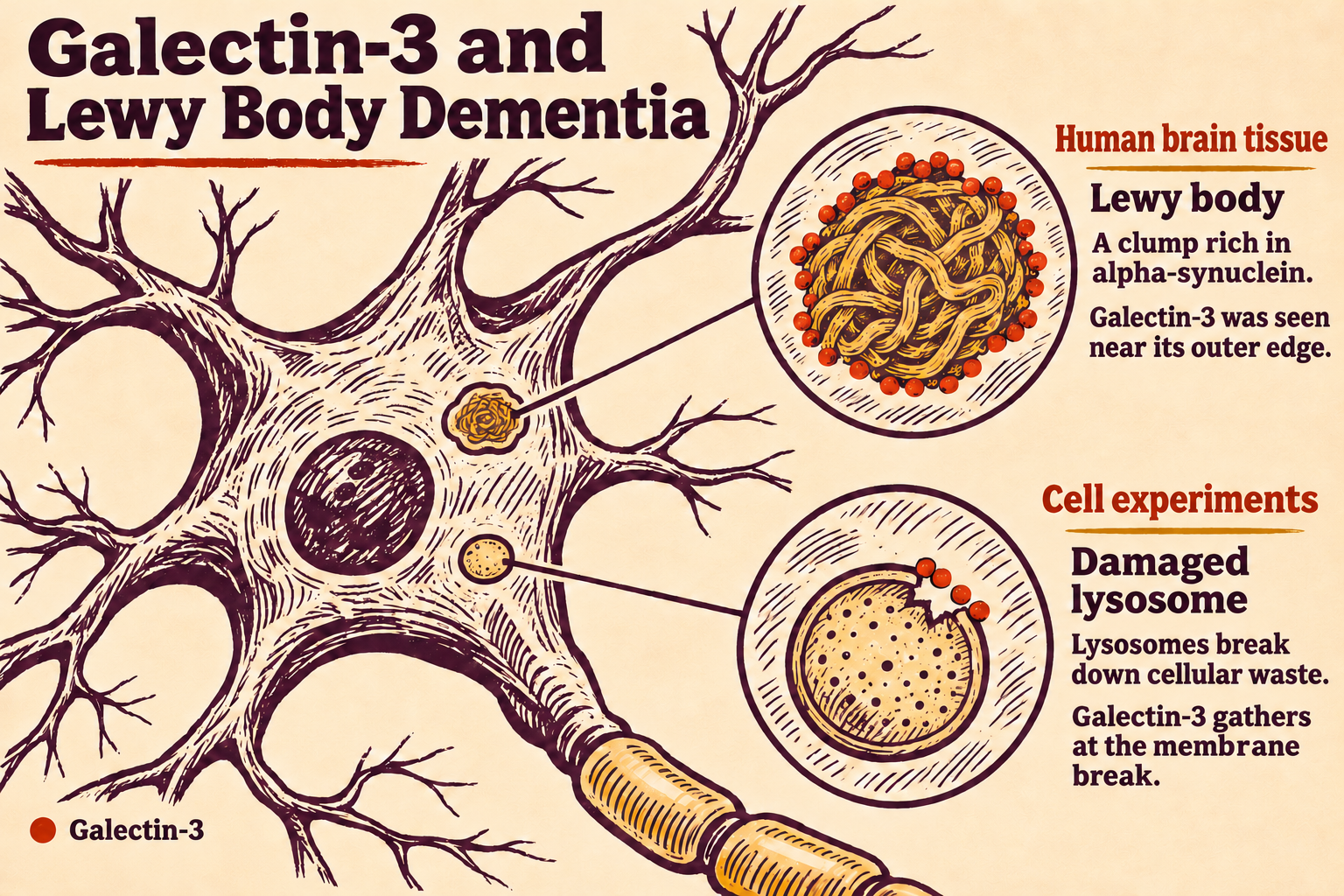
Researchers detected Galectin-3 within Lewy bodies, particularly around their outer ring, with some staining in inner regions. This provides a direct tissue-level connection between Galectin-3 and DLB pathology.
Tissue localization does not establish causation or treatment benefit. [1]
Lysosomal Membrane Damage Offers a Mechanistic Link
Endosomes and lysosomes are membrane-bound compartments involved in handling and breaking down cellular material. Their membrane integrity is an important subject in protein-aggregation research.
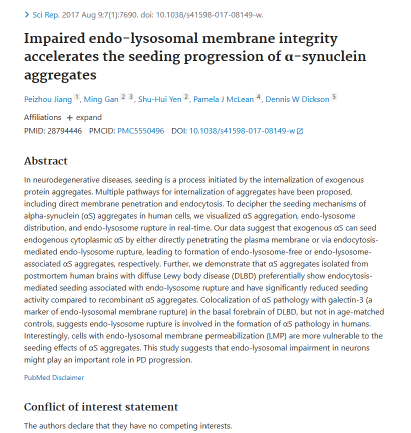
A 2017 study investigated how impaired endo-lysosomal membranes affect the seeding of alpha-synuclein aggregates. Galectin-3 was used as a marker of membrane damage in cell experiments.
The researchers also reported Galectin-3 associated with alpha-synuclein pathology in basal-forebrain tissue from people with diffuse Lewy body disease, compared with age-matched controls.
These findings connect abnormal protein accumulation with disrupted cellular compartments. They do not establish that Galectin-3 inhibition would restore those compartments in patients. [2]
Related Research Examines Protein Entry and Vesicle Rupture
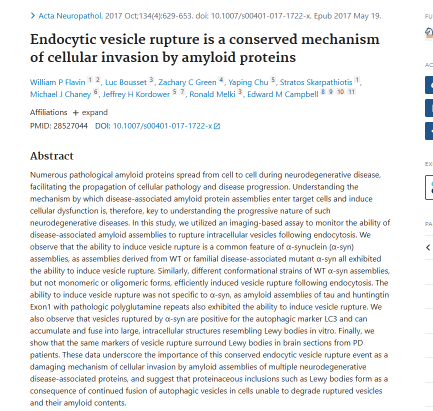
Another 2017 study investigated how disease-associated amyloid assemblies enter cells. It used imaging approaches to examine endocytic vesicle rupture, including Galectin-3-associated damage responses.
The work linked vesicle damage with cellular invasion by aggregation-prone proteins and examined Lewy-body-related pathology. This supports studying the handling of abnormal proteins as well as their final deposits.
This is mechanistic research across experimental systems and pathological samples, rather than a clinical trial showing that a treatment slows Lewy body dementia. [3]
Galectin-3 Can Alter Alpha-Synuclein Behavior in Models
The 2023 study also examined Galectin-3–alpha-synuclein interactions in cell and protein experiments, and in a Parkinson's-related mouse model.
Galectin-3 changed the organization and properties of alpha-synuclein fibrils. In the mouse experiments, genetic deletion of Galectin-3 preserved dopaminergic integrity and motor function despite increased intracellular alpha-synuclein accumulation.
These were Parkinson's-related experiments, not treatment trials in people with DLB. [1]
Neuroinflammation Is a Related Research Area
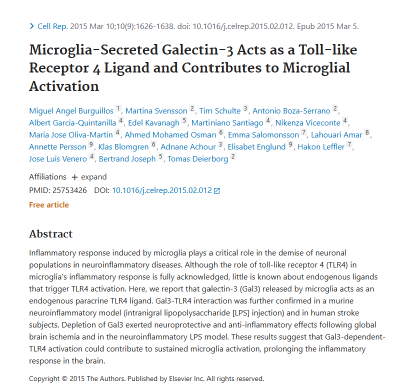
Galectin-3 is also studied in microglia, the brain's resident immune cells. A 2015 study showed that microglia-released Galectin-3 could interact with Toll-like receptor 4 (TLR4) and help sustain inflammatory activation in experimental systems.
This provides broader biological context for investigating Galectin-3 in neurodegeneration. It is not direct evidence that the same pathway drives every case of LBD, and the study was not a clinical treatment trial in DLB. [4]
Why Is Galectin-3 of Scientific Interest?
The research connects Galectin-3 with:
Lewy-body pathology: detection in post-mortem DLB tissue.
Cellular-compartment damage: recruitment to damaged membranes in experimental systems.
Protein interactions: effects on alpha-synuclein structure and toxicity in models.
Immune signaling: interactions with microglial activation pathways.
These connections justify further investigation, while leaving substantial questions about cause, timing, and clinical relevance.
The studies summarized here do not establish Galectin-3 as a stand-alone diagnostic test or demonstrate that Galectin-3-directed treatment slows Lewy body dementia. Tissue localization, mechanistic experiments, and treatment outcomes should be presented separately.
Scientific Foundations: The Evidence for Galectin-3 and Lewy Body Dementia
-
![]()
Journal: Acta Neuropathologica
Galectin-3 shapes toxic alpha-synuclein strains in Parkinson's disease (2023)
-
![]()
Journal: Scientific Reports
Impaired endo-lysosomal membrane integrity accelerates the seeding progression of α-synuclein aggregates (2017)
-
![]()
Journal: Acta Neuropathologica
Endocytic vesicle rupture is a conserved mechanism of cellular invasion by amyloid proteins (2017)
-
![]()
Journal: Cell Reports
Microglia-Secreted Galectin-3 Acts as a Toll-like Receptor 4 Ligand and Contributes to Microglial Activation (2015)