Beyond Dopamine: The Hidden Driver of Parkinson's Disease
How Gal3 Accelerates Parkinson's Disease
Recent breakthroughs from institutions like Lund University and the Michael J. Fox Foundation have revealed that Gal3 is not just an innocent bystander in this process. It actively accelerates the disease in three major ways:
1. The Toxic Sculptor
Gal3 physically interacts with alpha-synuclein. When α-Syn begins to clump, Gal3 binds directly to it, acting as a catalyst. Research shows that Gal3 actually shapes these protein clumps into highly toxic, short strains. It cements the α-Syn into tightly packed Lewy bodies, making it nearly impossible for the brain's natural waste disposal systems to break them down. In fact, post-mortem studies show that Lewy bodies in Parkinson's patients are often surrounded by a dense halo of Gal3.
2. The Accomplice in Spreading the Disease
Parkinson's is a progressive disease because the toxic α-Syn proteins spread from one brain cell to the next. When a cell tries to package up and dispose of the toxic α-Syn in tiny storage sacs (called vesicles), the toxic proteins often rupture the sacs. Gal3 swarms to these ruptured, stressed areas. Scientists now believe Gal3 plays a key role in the secretion and cell-to-cell transfer of these toxic proteins, effectively helping the disease "infect" neighboring healthy neurons.
3. The Fire-Starter (Microglial Hyper-Activation)
The brain has its own immune cells called microglia, which act as first responders.
The Overreaction: When toxic α-Syn starts clumping, microglia rush in to clean up the mess. The presence of the toxic α-Syn causes these microglia to produce massive amounts of Gal3.
The Feedback Loop: The newly produced Gal3 binds to receptors on the microglia, locking them into a state of chronic, aggressive inflammation.
The Collateral Damage: Instead of fixing the problem, the Gal3-fueled microglia release toxic inflammatory chemicals that destroy the highly vulnerable, dopamine-producing neurons nearby.
"In Parkinson's, Gal3 acts as both the glue that builds the toxic Lewy bodies and the spark that ignites chronic, neuron-killing brain inflammation."
The Genetic Connection
The link between Gal3 and Parkinson's isn't just microscopic; it is genetic. Massive genome-wide association studies have discovered that specific variations in the Gal3 gene (LGALS3) are strongly associated with a higher risk of developing Parkinson's disease. This genetic clue heavily reinforces that Gal3 is a core driver of the pathology, not just a side effect.
A New Horizon for Treatment
Because Gal3 sits at the exact intersection of toxic protein clumping and runaway neuroinflammation, it is emerging as one of the most promising therapeutic targets for Parkinson's disease in modern medicine.
Scientific Foundations: The Evidence for Galectin-3 and Parkinson’s
-
![]()
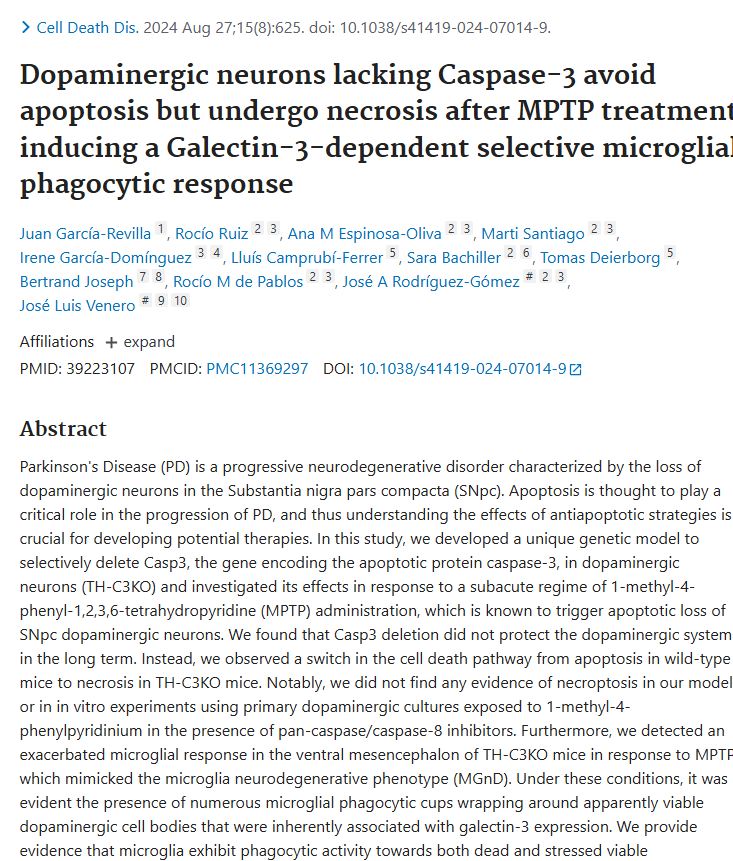
Journal: Cell Death & Disease
Dopaminergic neurons lacking Caspase-3 avoid apoptosis but undergo necrosis after MPTP treatment inducing a Galectin-3-dependent selective microglial phagocytic response (2024)
-
![]()
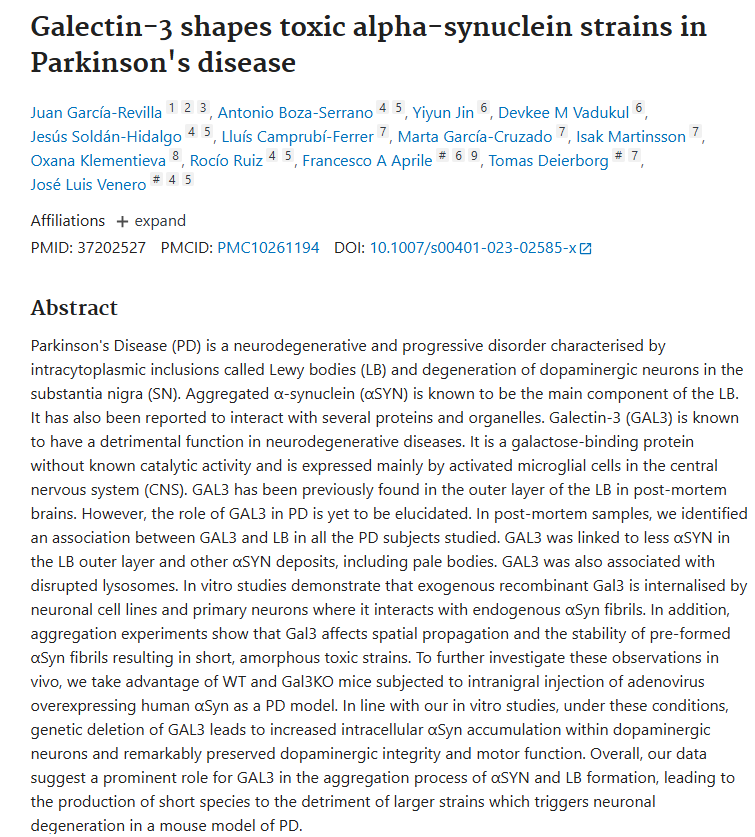
Journal: ACTA Neuropathologica
Galectin-3 shapes toxic alpha-synuclein strains in Parkinson's disease (2023)
-
![]()
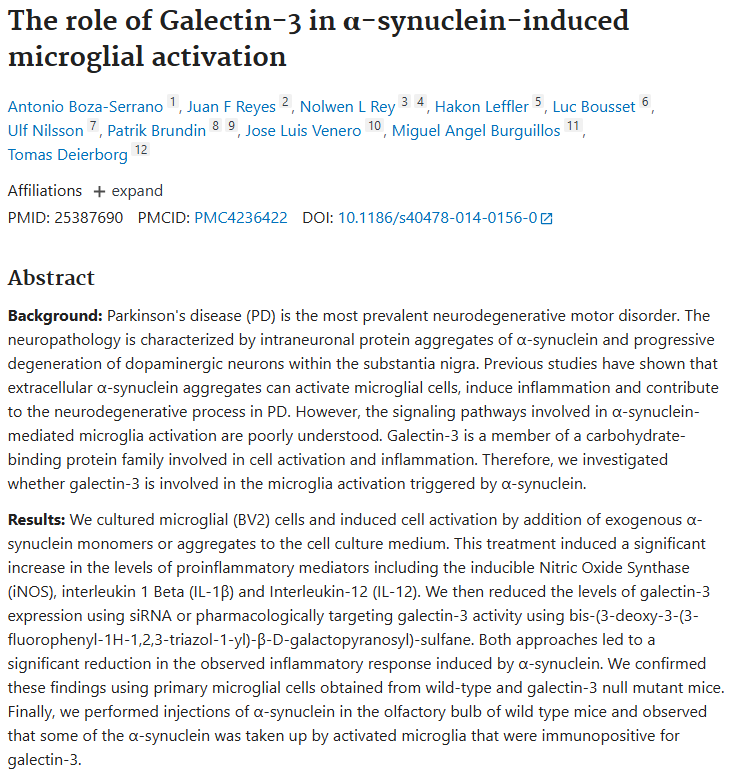
Journal: ACTA Neuropathologica
The role of Galectin-3 in α-synuclein-induced microglial activation (2014)
-
![]()
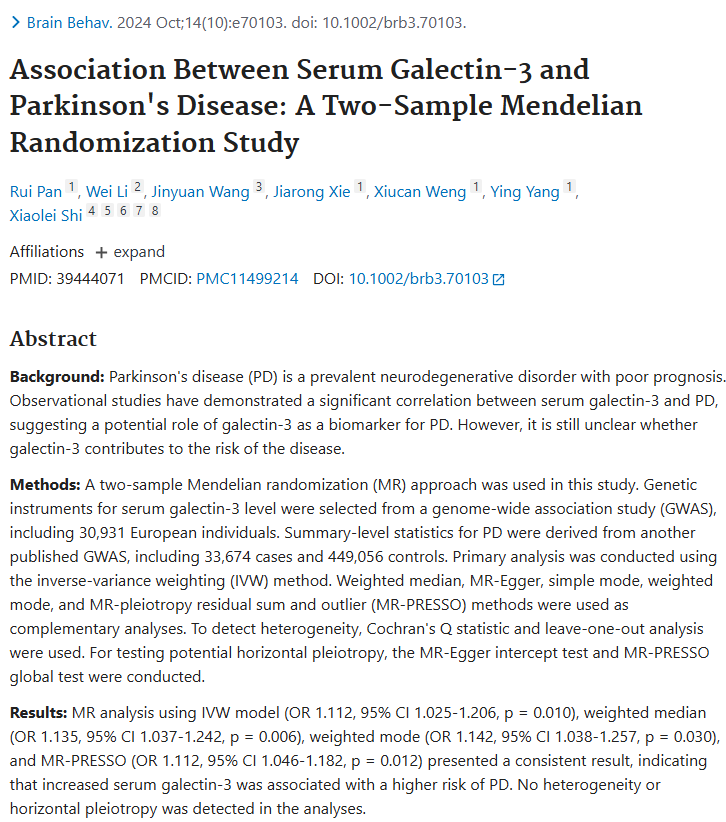
Journal: Brain and Behavior
Association Between Serum Galectin-3 and Parkinson's Disease: A Two-Sample Mendelian Randomization Study (2024)
-
![]()
Journal: Neural Regeneration Research
Galectin 3: A new player in the pathogenesis of Parkinson's disease (2025)